
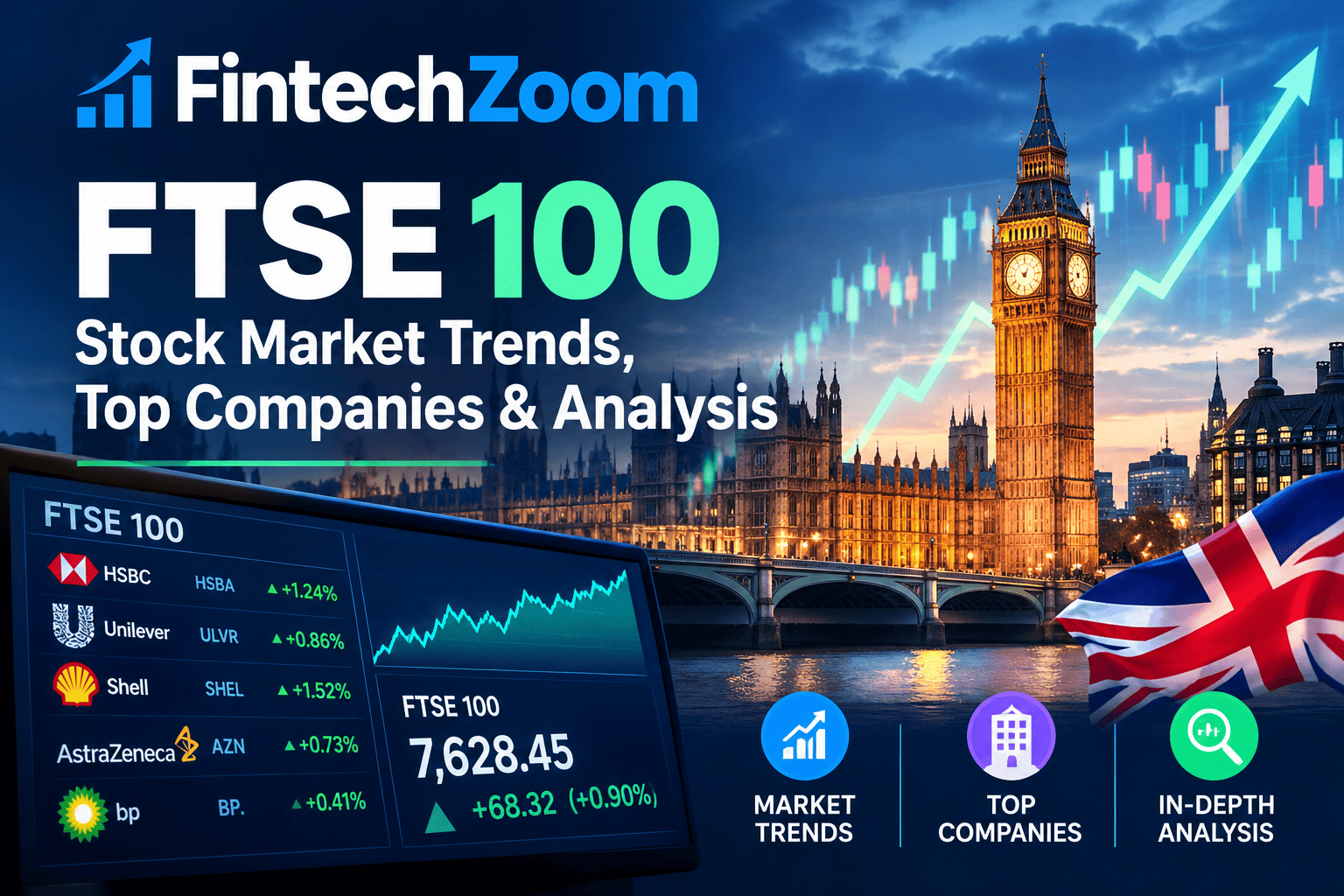
The FTSE 100 FintechZoom topic is useful for readers who want to understand the UK’s leading large-cap stock index, market trends, major listed companies, and the factors that influence share prices. The FTSE 100 is one of the most recognized benchmarks associated with the London Stock Exchange and is closely followed by investors, analysts, financial institutions, and market researchers.
However, understanding the FTSE 100 requires more than simply checking its daily price. Interest rates, inflation, currency movements, commodity prices, corporate earnings, global economic conditions, and sector performance can all affect the index.
This guide explores the FTSE 100 in detail while also showing how individual-stock research and broader market information can fit into a modern financial research process.
What Is the FTSE 100?
The FTSE 100 Index tracks 100 of the largest companies listed on the London Stock Exchange based on market capitalisation, subject to FTSE Russell’s eligibility and investability requirements.
The index was launched in 1984 and has become a major benchmark for large-cap UK-listed companies.
Although it is commonly described as a UK stock-market index, many FTSE 100 companies generate a substantial portion of their revenue outside the United Kingdom. This means the index can be influenced by international economic growth, commodity markets, exchange rates, and global investor sentiment.
FTSE 100 at a Glance
| Feature | Details |
| Index | FTSE 100 |
| Common ticker | UKX |
| Market | London Stock Exchange |
| Constituents | 100 companies |
| Segment | Large-cap equities |
| Launch year | 1984 |
| Review | Quarterly |
| Weighting | Market-cap based with investability adjustments |
The composition of the index can change over time, so investors should refer to the latest official FTSE Russell information when researching current constituents.
Why the FTSE 100 Matters
The FTSE 100 provides exposure to some of the largest companies listed in London. These businesses operate across numerous industries, giving the index a broad sector composition.
Some of the major sectors represented include:
- Financial services
- Energy
- Healthcare
- Consumer goods
- Consumer services
- Mining
- Industrials
- Telecommunications
- Utilities
This diversity means that different economic events can affect different parts of the index in different ways.
For example, higher commodity prices may benefit certain energy or mining companies, while higher interest rates can affect banks, consumers, property-related businesses, and equity valuations.
How Does the FTSE 100 Work?
The FTSE 100 is broadly weighted according to company market capitalisation, with FTSE Russell’s methodology also taking investability and free-float considerations into account.
In simple terms, larger companies generally have a greater influence on index movements than smaller companies.
Consider this simplified example:
| Company | Hypothetical Market Value | Potential Index Influence |
| Company A | £500 billion | Higher |
| Company B | £200 billion | Medium |
| Company C | £50 billion | Lower |
This is only an illustration. Actual FTSE 100 calculations follow the formal index methodology.
Understanding weighting is important because the FTSE 100’s daily movement does not necessarily mean that every company in the index moved by the same amount.
FTSE 100 FintechZoom and Market Research
When researching FTSE 100 FintechZoom, investors may be interested in more than the current index level.
A broader research approach can include:
- Index performance
- Sector movement
- Major constituent performance
- Corporate earnings
- Dividend announcements
- Interest-rate expectations
- Inflation data
- Currency movements
- Commodity prices
- Global market conditions
This approach helps provide context around why the index is moving.
For example, if the FTSE 100 rises strongly, analysts may investigate whether the move came from financial companies, energy businesses, mining stocks, healthcare companies, or several sectors simultaneously.
Major Companies Associated With the FTSE 100
The FTSE 100 contains many internationally recognized businesses.
Examples include:
- HSBC Holdings
- Shell
- BP
- AstraZeneca
- GSK
- Unilever
- Diageo
- Rio Tinto
- Barclays
- Lloyds Banking Group
- BAE Systems
- Rolls-Royce Holdings
These companies have different business models and therefore respond to different economic conditions.
Example Sector Exposure
| Sector | Examples of Relevant Factors |
| Banking | Interest rates, lending, credit conditions |
| Energy | Oil and gas prices, production |
| Healthcare | Drug development, regulation, healthcare demand |
| Mining | Metals prices, global industrial demand |
| Consumer | Spending, inflation, economic growth |
| Defence & Aerospace | Government spending, contracts, global demand |
| Telecommunications | Subscriber growth, pricing, regulation |
FTSE 100 Stock Market Trends
FTSE 100 trends are influenced by both domestic and international developments.
Some of the most important factors include:
Interest Rates
Bank of England monetary policy can influence borrowing costs, financial stocks, consumer demand, bond yields, and equity valuations.
Inflation
Inflation affects household purchasing power, company costs, consumer spending, and central-bank policy expectations.
Commodity Prices
Oil, natural gas, copper, iron ore, gold, and other commodities can influence companies operating in energy and mining industries.
Currency Movements
The pound can be particularly relevant because many large FTSE 100 companies generate international revenues.
Global Economic Growth
The FTSE 100 includes multinational companies, so economic conditions in Europe, North America, Asia, and other regions can influence company revenues and investor sentiment.
FintechZoom.com Stock Market and FTSE 100 Research
The broader FintechZoom.com Stock Market concept can be useful when looking at the FTSE 100 alongside individual stocks and wider financial-market developments.
A stock-market research process might compare:
| Research Area | What to Examine |
| Indexes | FTSE 100, FTSE 250 and other benchmarks |
| Individual stocks | Price, earnings and company news |
| Sectors | Financials, energy, healthcare, mining and others |
| Economy | Inflation, GDP and employment |
| Monetary policy | Interest rates and central-bank guidance |
| Commodities | Oil, gas and metals |
| Currency | GBP and major currency pairs |
| Global markets | US, European and Asian markets |
Looking at these areas together can provide a more complete picture than following a single index number.
FintechZoom SQ Stock: Understanding Individual Stock Research
While the FTSE 100 focuses on large companies listed in London, readers may also encounter searches for FintechZoom SQ Stock when researching individual companies in the broader stock market.
SQ is the ticker associated with Block, Inc., a US-based financial technology company. Its shares are therefore separate from the FTSE 100.
This distinction is important when researching financial markets because an individual stock and an index can have very different risk characteristics.
FTSE 100 vs Individual Stock
| Feature | FTSE 100 | Individual Stock |
| Type | Stock index | Company security |
| Diversification | Multiple companies | One company |
| Geographic exposure | London-listed companies | Depends on company |
| Main drivers | Multiple sectors and companies | Company-specific factors plus market conditions |
| Risk concentration | Spread across constituents | More concentrated |
| Analysis | Index and sector factors | Company fundamentals and stock-specific factors |
For example, research into SQ stock would focus heavily on the company’s revenue growth, profitability, business strategy, competitive environment, financial results, and management outlook. FTSE 100 research instead considers a much broader group of companies and sectors.
FTSE 100 vs FTSE 250
The FTSE 100 and FTSE 250 represent different segments of the UK-listed equity market.
| Feature | FTSE 100 | FTSE 250 |
| Main companies | Large-cap | Mid-cap |
| Constituents | 100 | 250 |
| International exposure | Often significant | More varied |
| Domestic UK exposure | Varies by company | Often more significant |
| Main use | Large-cap benchmark | Mid-cap benchmark |
Because the two indexes contain different companies, their performance can diverge during different economic periods.
FTSE 100 Sector Analysis
Financial Services
Banks and insurers can be influenced by:
- Interest rates
- Credit demand
- Loan growth
- Default rates
- Net interest margins
- Regulation
- Economic growth
Changes in monetary policy can therefore affect financial companies significantly.
Energy
Energy companies can respond to:
- Crude oil prices
- Natural gas prices
- Global demand
- Production levels
- Government policy
- Geopolitical developments
Because some energy businesses are large index constituents, movements in this sector can affect the wider FTSE 100.
Healthcare
Healthcare and pharmaceutical companies can be affected by:
- Drug approvals
- Clinical developments
- Patent protection
- Healthcare spending
- Regulatory decisions
- Research and development
Mining
Mining companies are particularly sensitive to commodity prices.
Important commodities include:
- Copper
- Iron ore
- Gold
- Aluminium
- Other industrial metals
Global industrial demand, especially from major manufacturing economies, can influence these businesses.
What Moves the FTSE 100?
There is no single factor that determines FTSE 100 performance. Several variables can interact at the same time.
Key Market Drivers
- Bank of England interest-rate decisions
- UK inflation
- Global economic growth
- Commodity prices
- GBP exchange rates
- Corporate earnings
- Bond yields
- Geopolitical developments
- Investor sentiment
- Sector-specific news
A daily market move should therefore be viewed in context.
How to Analyze FTSE 100 Stocks
Investors researching FTSE 100 companies can combine fundamental and market analysis.
Fundamental Analysis
Fundamental research may include:
- Revenue
- Earnings
- Profit margins
- Cash flow
- Debt
- Dividends
- Return on capital
- Competitive position
- Management guidance
Technical Analysis
Technical analysis may examine:
- Moving averages
- Support and resistance
- Trading volume
- Momentum
- Relative Strength Index
- Price trends
- Volatility
Neither approach provides certainty about future prices. They are tools for organizing and interpreting market information.
FTSE 100 Dividends
Dividends are an important consideration for many investors researching established UK-listed companies.
A dividend represents a distribution of company profits or available capital to shareholders, subject to the company’s financial position and board decisions.
When researching dividends, consider:
| Metric | Why It Matters |
| Dividend yield | Relates dividend payments to share price |
| Payout ratio | Shows dividends relative to earnings |
| Free cash flow | Helps assess cash available for distributions |
| Dividend history | Shows previous payment patterns |
| Debt | Can affect financial flexibility |
| Earnings | Supports the company’s ability to maintain payments |
A high dividend yield should not automatically be interpreted as a sign of strength. The share price may have declined, or the market may be expecting future changes in the dividend.
FTSE 100 ETFs and Index Funds
Investors seeking broad FTSE 100 exposure may consider products designed to track the index.
Depending on jurisdiction, these can include:
- ETFs
- Index funds
- Other index-tracking products
Before considering such a product, investors should review:
- Fund fees
- Tracking difference
- Fund structure
- Dividend treatment
- Trading costs
- Liquidity
- Tax treatment
- Currency exposure
The details vary between products and jurisdictions.
Risks of Investing in the FTSE 100
Although diversification across 100 companies can reduce some company-specific risk, the FTSE 100 remains exposed to market risk.
Important risks include:
- Share-price volatility
- Economic downturns
- Inflation
- Interest-rate changes
- Currency fluctuations
- Commodity-price movements
- Geopolitical events
- Regulatory changes
- Company-specific problems
- Dividend reductions
Investors should consider their own circumstances, objectives, time horizon, and risk tolerance before making financial decisions.
How to Research the FTSE 100 More Effectively
A structured research process can make market information easier to interpret.
Step 1: Check the Index
Review the latest FTSE 100 level and daily percentage change.
Step 2: Examine Sector Performance
Determine which sectors are contributing to gains or losses.
Step 3: Review Major Constituents
Look at large companies that may have a substantial influence on the index.
Step 4: Review Economic Data
Monitor inflation, GDP, employment, interest rates, and consumer indicators.
Step 5: Track Commodities
Pay attention to oil, gas, metals, and other commodities relevant to major constituents.
Step 6: Review Corporate Results
Analyze revenue, earnings, margins, cash flow, debt, and management guidance.
Step 7: Compare Different Time Periods
Compare daily, weekly, monthly, and longer-term performance rather than relying on a single trading session.
FTSE 100 and the Broader Stock Market
The FTSE 100 is only one component of the global financial system.
Investors researching the FintechZoom.com Stock Market landscape may also examine:
- FTSE 250
- S&P 500
- Nasdaq
- Dow Jones
- European indexes
- Asian indexes
- Government bonds
- Commodities
- Currencies
- Cryptocurrency markets
Comparing different asset classes can help explain why financial markets move in different directions.
For example, a stronger dollar, changing bond yields, or a major commodity-price movement can influence multiple markets simultaneously.
FTSE 100 Market Outlook
Instead of relying on a single forecast, investors can monitor the fundamental factors that may influence the index over time.
Important areas include:
Monetary Policy
Interest-rate decisions and central-bank guidance can influence financial conditions.
Inflation
Changing inflation can affect consumer spending, company costs, and interest-rate expectations.
Corporate Earnings
Revenue and earnings growth can provide information about company performance.
Global Growth
Because many FTSE 100 companies operate internationally, global economic activity is important.
Commodity Markets
Energy and mining companies can be sensitive to commodity-price movements.
Currency Markets
Sterling movements can affect the reported value of international revenues.
Frequently Asked Questions
What is FTSE 100 FintechZoom?
FTSE 100 FintechZoom is a search phrase associated with information about the FTSE 100, including market trends, major companies, stock analysis, and financial-market developments.
What does the FTSE 100 represent?
The FTSE 100 represents 100 of the largest companies listed on the London Stock Exchange according to FTSE Russell’s index methodology.
Is the FTSE 100 the same as the UK economy?
No. The FTSE 100 is an equity-market index, not a complete measure of the UK economy. Many companies in the index have substantial international operations.
What companies are included in the FTSE 100?
The index includes large companies from sectors such as financial services, energy, healthcare, consumer products, mining, industrials, and telecommunications. Constituents can change following index reviews and corporate events.
What is FintechZoom SQ Stock?
FintechZoom SQ Stock refers to searches about SQ, the ticker associated with Block, Inc. SQ is a US-listed individual company rather than a FTSE 100 constituent.
What is FintechZoom.com Stock Market?
The phrase FintechZoom.com Stock Market can refer broadly to stock-market research covering indexes, individual companies, market trends, sectors, and financial developments.
What factors affect the FTSE 100?
Interest rates, inflation, commodity prices, exchange rates, global economic growth, corporate earnings, bond yields, and geopolitical developments can all influence the index.
Can beginners invest in the FTSE 100?
Depending on their country and brokerage access, beginners may be able to obtain FTSE 100 exposure through ETFs or index funds. They should review costs, risks, taxation, and product details before investing.
Final Thoughts
The FTSE 100 FintechZoom topic provides a useful starting point for understanding one of London’s most widely followed stock indexes. However, meaningful market analysis requires more than watching the index’s daily movement.
Investors and researchers can examine sector performance, company earnings, dividends, interest rates, inflation, commodity prices, currency movements, and global economic conditions to develop a broader understanding of market behavior.
The related FintechZoom.com Stock Market concept can also help place the FTSE 100 within the wider financial landscape, while FintechZoom SQ Stock illustrates the difference between researching an individual US-listed company and analyzing a diversified stock index.
By combining index-level data with company fundamentals and macroeconomic information, readers can better understand the forces shaping the stock market while recognizing that market prices and investment outcomes remain uncertain.
[…] Stock Market: A Complete Guide to Market Trends & Analysis FTSE 100 FintechZoom: Stock Market Trends, Top Companies & Analysis FintechZoom SQ Stock: Price Trends, Market Insights & Future Outlook FintechZoom.com ETF […]