
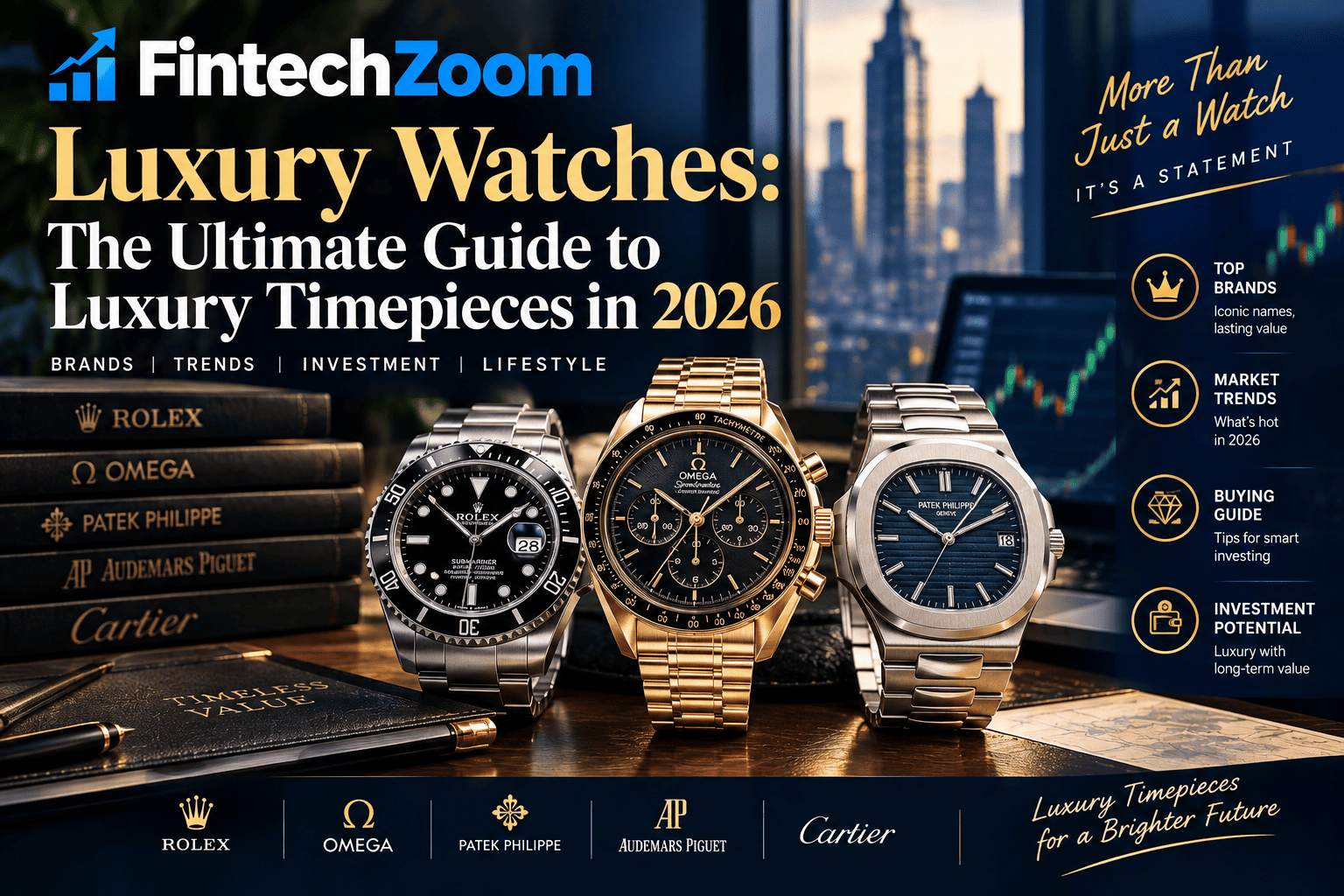
Luxury watches have evolved far beyond simple timekeeping. Today, they represent craftsmanship, heritage, design, engineering, personal style, and, in some cases, collectible value. From Swiss mechanical masterpieces to modern high-end timepieces, the luxury watch industry continues to attract collectors, enthusiasts, and first-time buyers.
FintechZoom Luxury Watches provides a useful way to explore the broader world of premium watches, including luxury brands, market trends, pricing considerations, popular styles, and factors that can influence a watch’s long-term appeal.
Whether you are researching your first luxury watch or simply interested in the latest developments in the industry, this guide explains the key things to know in 2026.
What Are Luxury Watches?
Luxury watches are premium timepieces distinguished by their craftsmanship, materials, mechanical movements, finishing, brand heritage, and attention to detail.
Unlike mass-market watches, luxury timepieces often involve extensive manufacturing processes and specialized expertise. Some mechanical watches contain hundreds of individual components working together to measure time.
Common characteristics include:
- High-quality mechanical or automatic movements
- Premium metals and materials
- Detailed hand finishing
- Sapphire crystal
- Limited or carefully controlled production
- Strong brand heritage
- Specialized complications
- Distinctive designs
- Collectible or resale appeal
The definition of luxury can vary considerably. A prestigious brand is important, FintechZoom Asian Markets Today but craftsmanship, originality, condition, rarity, and provenance can also contribute significantly to a watch’s desirability.
Why Luxury Watches Remain Popular in 2026
The luxury watch market continues to attract consumers for several reasons. Some buyers appreciate mechanical engineering, while others value design, history, exclusivity, or craftsmanship.
1. Exceptional Craftsmanship
High-end watchmaking can involve meticulous assembly, finishing, testing, and quality control. Components that are almost invisible to the wearer may receive significant attention from manufacturers.
2. Heritage and Brand Recognition
Established watchmakers often have decades or centuries of history. Their designs can become closely associated with particular eras, personalities, sporting events, or technical achievements.
3. Personal Style
A luxury watch can complement formal clothing, business attire, or casual outfits. Different case sizes, dial colors, bracelets, and complications allow buyers to choose a style that matches their preferences.
4. Collecting
Some enthusiasts collect watches based on brand, model family, movement, historical importance, or rarity.
5. Long-Term Ownership
Unlike disposable consumer products, a well-maintained mechanical watch can potentially remain functional for decades. Servicing and maintenance are important parts of long-term ownership.
Popular Luxury Watch Brands
The luxury watch sector includes numerous manufacturers with distinctive histories and product strategies.
| Brand | Commonly Associated With | Typical Appeal |
| Rolex | Iconic sports and dress watches | Recognition, durability, heritage |
| Patek Philippe | Complicated and classic watches | Craftsmanship and exclusivity |
| Audemars Piguet | High-end sports watches | Distinctive design and horology |
| Omega | Professional and heritage watches | Technical innovation and history |
| Cartier | Elegant dress watches | Design and jewelry heritage |
| Vacheron Constantin | Traditional high watchmaking | Heritage and craftsmanship |
| Jaeger-LeCoultre | Mechanical innovation | Movements and complications |
| IWC Schaffhausen | Pilot and classic watches | Engineering and functional design |
| Breitling | Aviation-inspired watches | Instrument-style designs |
| Grand Seiko | Precision and finishing | Japanese craftsmanship |
The best-known brands are not necessarily FintechZoom Apple Stock identical in design philosophy or target customer. Buyers should therefore compare individual models rather than relying only on brand reputation.
Understanding Mechanical, Automatic, and Quartz Watches
One of the first decisions for a luxury-watch buyer is choosing the type of movement.
Mechanical Watches
Mechanical watches operate through a mainspring and a complex system of gears, springs, and other components.
They are often appreciated for:
- Traditional watchmaking
- Mechanical complexity
- Hand craftsmanship
- Collectibility
- Horological heritage
Automatic Watches
An automatic watch is a mechanical watch that can wind itself through the movement of the wearer’s wrist.
Automatic movements combine traditional mechanical watchmaking with convenient everyday operation.
Quartz Watches
Quartz watches use electronic regulation based on a quartz crystal. They are generally known for excellent timekeeping accuracy and convenient operation.
Although mechanical watches dominate much of the traditional luxury segment, high-end quartz watches can also offer sophisticated construction and distinctive design.
Key Luxury Watch Features to Understand
Before purchasing a luxury timepiece, it helps to understand the terminology used by manufacturers and collectors.
Movement
The movement is the mechanism responsible for powering and regulating the watch.
Complications
A complication is an additional function beyond basic timekeeping.
Examples include:
- Chronograph
- Date display
- GMT
- Moon phase
- Annual calendar
- Perpetual calendar
- Power-reserve indicator
- Minute repeater
- Tourbillon
Water Resistance
Water resistance indicates how a watch is designed to handle exposure to water under specified conditions. It should not automatically be interpreted as a guarantee that the watch is suitable for every underwater activity.
Sapphire Crystal
Sapphire crystal is commonly used in premium watches because of its strong resistance to scratching.
Power Reserve
Power reserve refers to approximately how long a mechanical watch can continue operating after it has been fully wound.
Luxury Watch Materials
Materials can have a major influence on appearance, durability, weight, and price.
Common materials include:
- Stainless steel
- Titanium
- Ceramic
- Platinum
- Yellow gold
- White gold
- Rose gold
- Sapphire crystal
- High-grade leather
- Precious stones
Stainless Steel
Stainless steel is popular for sports and everyday luxury watches because it combines durability with a versatile appearance.
Gold
Gold provides a more traditional luxury aesthetic. Different gold alloys can create different colors and visual characteristics.
Platinum
Platinum is dense, precious, and often associated with high-end watchmaking.
Ceramic
Advanced ceramics can offer excellent scratch resistance and a contemporary appearance.
How Much Do Luxury Watches Cost?
Luxury-watch prices can range from several thousand dollars to hundreds of thousands of dollars or more, depending on the brand, model, materials, complications, rarity, and market conditions.
A simplified overview:
| Category | General Price Range |
| Entry-level luxury | $2,000–$5,000+ |
| Established luxury | $5,000–$15,000+ |
| High-end luxury | $15,000–$50,000+ |
| Haute horlogerie | $50,000+ |
| Rare/exceptional pieces | Can exceed $100,000 |
These are broad categories rather than fixed market prices. Individual watches can fall substantially outside these ranges.
What Determines a Luxury Watch’s Value?
Price and value are not always the same thing.
Several factors can affect the market value of a luxury watch.
Brand
Well-established brands often have strong recognition among collectors and consumers.
Model
Some models have greater demand than others because of their design, history, production numbers, or reputation.
Condition
A well-preserved watch with original components and appropriate servicing can be more desirable than a heavily worn or modified example.
Rarity
Limited production, discontinued references, unusual configurations, or historically important examples may attract collector interest.
Provenance
Documentation and ownership history can sometimes contribute to the desirability of collectible watches.
Originality
Original parts, dial, hands, bezel, and other components can matter significantly in the collector market.
Luxury Watches as Collectibles
Luxury watches are frequently discussed as collectibles, but buyers should distinguish collecting from investing.
A watch may increase in market value, remain relatively stable, or decline in value. Past performance does not guarantee future appreciation.
For collectors, the most important considerations may include:
- Historical significance
- Design
- Condition
- Rarity
- Manufacturer
- Documentation
- Originality
- Long-term interest among collectors
Rather than purchasing solely because a watch is expected to appreciate, many enthusiasts focus on finding a timepiece they genuinely enjoy owning.
How to Choose the Right Luxury Watch
Choosing a luxury watch should begin with your personal requirements rather than simply selecting the most expensive option.
Step 1: Set a Budget
Determine how much you are comfortable spending, including potential servicing, insurance, taxes, and accessories.
Step 2: Decide the Purpose
Ask yourself whether the watch will be used for:
- Everyday wear
- Business occasions
- Formal events
- Travel
- Sports
- Collecting
Step 3: Choose a Style
Consider whether you prefer:
- Classic
- Sporty
- Minimalist
- Vintage-inspired
- Modern
- Complicated
- Dress-oriented designs
Step 4: Select the Movement
Compare mechanical, automatic, and quartz options based on your preferences for maintenance, accuracy, craftsmanship, and convenience.
Step 5: Research the Model
Study the watch’s specifications, history, dimensions, movement, materials, warranty, and servicing requirements.
Step 6: Verify Authenticity
When buying an expensive watch, authentication should be a priority.
New vs. Pre-Owned Luxury Watches
Buyers can generally choose between purchasing a new watch from an authorized retailer or buying a pre-owned example.
| Factor | New Watch | Pre-Owned Watch |
| Condition | New | Varies |
| Warranty | Usually manufacturer-backed | Depends on seller |
| Price | Usually higher | Can be lower or vary |
| Availability | Depends on production | Can include discontinued models |
| History | No previous ownership | May have ownership/service history |
| Collectibility | Depends on model | Can include vintage examples |
The pre-owned market can provide access to discontinued references and older models, but buyers should pay close attention to authenticity, condition, service history, and seller reputation.
How to Buy a Luxury Watch Safely
Luxury watches can involve significant financial transactions, so buyers should conduct proper research before purchasing.
Important checks include:
- Verify the seller’s reputation.
- Request clear photographs and detailed specifications.
- Check serial and reference information where appropriate.
- Ask about service history.
- Confirm whether original documentation is included.
- Understand the return policy.
- Compare prices across reputable sources.
- Consider professional authentication for expensive purchases.
- Avoid deals that appear suspiciously cheap.
For valuable vintage or collectible watches, independent authentication can be particularly useful.
Luxury Watch Maintenance
A mechanical luxury watch is a precision instrument and requires appropriate care.
Good maintenance practices include:
- Keep the watch clean and dry.
- Follow manufacturer recommendations.
- Avoid unnecessary impacts.
- Store it safely when not being worn.
- Have water resistance checked when appropriate.
- Service the movement according to manufacturer guidance.
- Use qualified watchmakers for repairs.
Regular maintenance can help preserve both functionality and appearance.
Luxury Watch Trends to Watch in 2026
The luxury-watch industry continues to evolve as consumer preferences change.
Several areas remain important for enthusiasts:
Vintage-Inspired Designs
Many manufacturers continue to draw inspiration from historic models while incorporating modern movements and materials.
Smaller Case Sizes
Consumer preferences can shift over time, and more compact watches have gained attention among buyers who prefer understated proportions.
Integrated-Bracelet Designs
Watches featuring cases and bracelets designed as a unified visual concept remain an important category within luxury sports watches.
Independent Watchmakers
Smaller independent manufacturers continue to attract enthusiasts interested in unusual designs, specialized craftsmanship, and limited production.
Digital Research
Consumers increasingly research specifications, prices, reviews, auction results, and market history online before making purchasing decisions.
FintechZoom Luxury Watches and Market Research
When researching FintechZoom Luxury Watches, it is useful to look beyond a single price or headline. The luxury-watch market involves several interconnected factors, including consumer demand, brand strategy, production, economic conditions, secondary-market activity, and collector sentiment.
A well-rounded research process can include:
- Comparing retail and secondary-market prices.
- Reviewing model specifications.
- Studying historical price movements where reliable data is available.
- Checking auction activity for collectible pieces.
- Comparing similar models from competing brands.
- Monitoring new releases and discontinued references.
- Considering long-term ownership and servicing costs.
This approach provides more context than looking at price alone.
Common Mistakes Luxury Watch Buyers Should Avoid
First-time buyers sometimes focus too heavily on brand recognition and overlook practical considerations.
Avoid these common mistakes:
- Buying only because a watch is expensive
- Ignoring wrist size and comfort
- Failing to research the movement
- Purchasing from an unverified seller
- Assuming every luxury watch appreciates in value
- Neglecting service costs
- Ignoring authenticity
- Buying a model that does not suit your lifestyle
- Overlooking warranty terms
- Making a rushed purchase because of perceived scarcity
Frequently Asked Questions
What is FintechZoom Luxury Watches?
FintechZoom Luxury Watches refers to the topic of luxury timepieces viewed through the lens of market information, brands, pricing, trends, and watch-industry analysis.
Are luxury watches a good investment?
Luxury watches should not automatically be treated as investments. Their market values can rise or fall depending on demand, condition, rarity, brand, model, and broader market conditions.
Which luxury watch should a beginner buy?
A beginner should consider factors such as budget, intended use, preferred design, case size, movement type, service requirements, and brand reputation before selecting a model.
Are expensive watches more durable?
Not necessarily. Price can reflect craftsmanship, materials, complications, brand positioning, and rarity. Durability depends on the specific watch and how it is designed and maintained.
Should I buy a new or pre-owned luxury watch?
Both options have advantages. New watches offer a new condition and typically straightforward warranty arrangements, while pre-owned watches can provide access to older or discontinued models and different pricing.
How often should a luxury watch be serviced?
Service intervals vary by manufacturer, movement, usage, and watch condition. The manufacturer’s current servicing recommendations should be used as the primary reference.
Do luxury watches hold their value?
Some models can retain value relatively well, while others depreciate. There is no universal guarantee that a luxury watch will maintain or increase its market price.
Final Thoughts
FintechZoom Luxury Watches highlights the major factors that shape today’s luxury-watch market. From mechanical movements and premium materials to brand heritage, collectibility, pricing, and maintenance, there is much more to luxury watchmaking than simply telling time.
For prospective buyers, the smartest approach is to research the specific model carefully, verify authenticity, understand ownership costs, and choose a watch that fits both personal preferences and practical needs.
Whether your interest is classic watchmaking, modern sports watches, vintage pieces, or independent brands, understanding the fundamentals can make the luxury-watch journey more informed and enjoyable.
[…] Asian Markets Today: A Complete Guide to Asian Stock Markets FintechZoom Luxury Watches: The Ultimate Guide to Luxury Timepieces in 2026 FintechZoom Apple Stock: Price Trends, Market Insights & Future Outlook FintechZoom.com […]
[…] Asian Markets Today: A Complete Guide to Asian Stock Markets FintechZoom Luxury Watches: The Ultimate Guide to Luxury Timepieces in 2026 FintechZoom Apple Stock: Price Trends, Market Insights & Future Outlook FintechZoom.com […]