
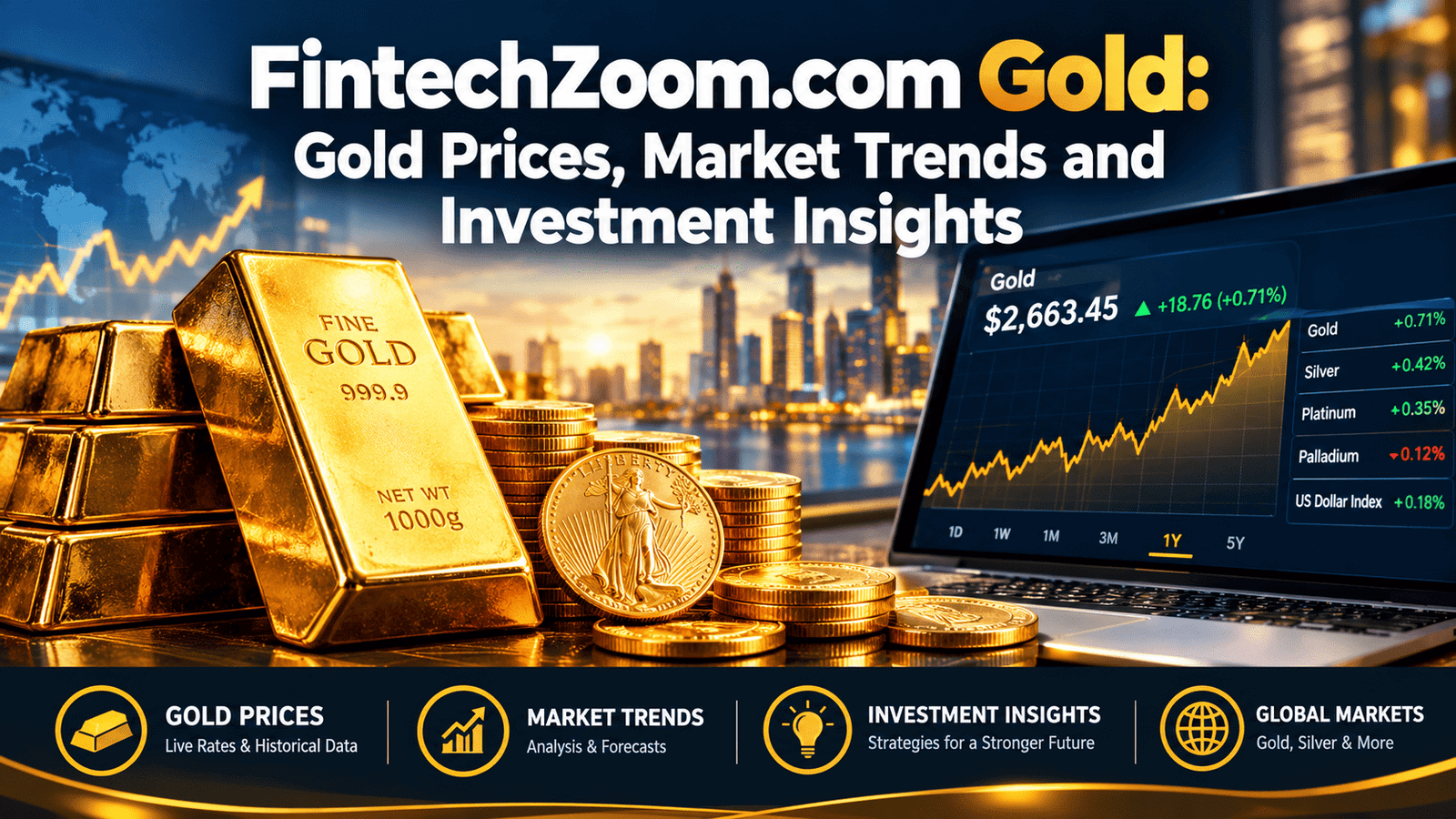
FintechZoom.com Gold is a useful topic for readers researching gold prices, market trends, economic influences, and investment considerations. Gold prices can respond to interest rates, inflation expectations, the U.S. dollar, central-bank demand, geopolitical developments, and investor sentiment. Understanding these factors alongside broader financial-market trends can provide a more complete view of why gold prices move and how gold differs from stocks, bonds, and other assets.
What Is FintechZoom.com Gold?
The term FintechZoom.com Gold can be used to describe gold-related financial information, market analysis, pricing discussions, and investment insights associated with the FintechZoom topic.
Gold has a unique position in financial markets because it is both a physical commodity and a monetary asset. Unlike a company stock, gold does not represent ownership of a business. It also does not normally produce earnings, dividends, or interest.
Instead, its market value is influenced by supply and demand and by investors’ expectations about the economy and financial system.
This makes gold analysis different from conventional stock analysis. Investors studying gold often pay close attention to interest rates, real yields, inflation expectations, currency movements, central-bank purchases, geopolitical uncertainty, and investment demand.
Why Gold Prices Matter to Investors
Gold prices attract attention from individual investors, institutions, central banks, traders, and businesses involved in the precious-metals industry.
The gold price can influence:
| Area | Why It Matters |
| Physical bullion | Determines the underlying market value of gold |
| Gold ETFs | Influences the value of gold-linked investments |
| Mining companies | Can affect revenue and profitability expectations |
| Jewelry markets | Changes the cost of gold-based products |
| Central-bank reserves | Influences official-sector demand |
| Currency markets | Gold is commonly quoted in U.S. dollars |
| Investment portfolios | Can affect diversification decisions |
However, a rising gold price does not automatically mean every gold-related investment will increase by the same amount.
A gold-mining company, for example, has operating costs, debt, management risks, production challenges, and geopolitical exposure that physical gold does not have.
How Gold Prices Are Determined
Gold trades in a global market involving financial institutions, bullion dealers, exchanges, miners, central banks, industrial users, and investors.
The internationally followed spot gold price represents the market value associated with gold transactions for near-term delivery. Futures prices, meanwhile, represent standardized contracts for future transactions.
Several major forces can influence gold prices.
Interest Rates
Interest rates are an important part of gold-market analysis.
Because gold does not generate regular interest payments, changes in yields on other assets can influence its relative attractiveness.
When interest rates or real yields rise, some investors may prefer income-producing assets. When yields decline, gold can become relatively more attractive to certain investors.
This relationship is not guaranteed because gold prices are influenced by several factors simultaneously.
Inflation Expectations
Gold is frequently discussed as a potential store of value during periods of inflation.
However, inflation alone does not determine gold prices. Investors also consider whether inflation is temporary or persistent, how central banks are responding, and what is happening with real interest rates and currencies.
Therefore, simply seeing higher inflation does not provide enough information to predict gold’s next move.
The U.S. Dollar
The U.S. dollar is particularly important because international gold prices are commonly quoted in dollars.
Changes in the dollar’s value can influence the price of gold in dollar terms and affect how expensive gold becomes for international buyers.
For this reason, people researching gold prices often monitor currency-market movements alongside precious-metal prices.
Central Banks and Gold
Central banks are major participants in the international gold market.
Gold can form part of a country’s official reserves, giving central banks a reason to buy, hold, or sell bullion depending on their reserve-management objectives.
Changes in official-sector demand can therefore become an important theme for gold-market observers.
Central-bank purchases should not be considered a standalone signal, however. Gold prices are influenced by numerous variables, including interest rates, currencies, investment flows, physical demand, and expectations about future economic conditions.
A strong analysis therefore looks at central-bank activity as one component of a broader market picture.
FintechZoom Market Insights and Financial Trends
Gold analysis becomes more useful when it is placed within the broader financial environment.
FintechZoom Market Insights and Financial Trends can be viewed as a broader research concept covering the relationship between financial markets, economic developments, investment sentiment, and asset prices.
For gold investors, this broader perspective matters because precious metals are connected to other markets.
For example, changes in interest rates can affect bond yields and currencies while also influencing gold. Similarly, changes in economic expectations can influence stock prices, commodities, and investor demand for defensive assets.
Instead of examining gold in isolation, investors can monitor several indicators together:
| Indicator | Relevance to Gold |
| Interest rates | Can influence opportunity cost |
| Bond yields | Important for relative asset attractiveness |
| U.S. dollar | Can affect dollar-denominated gold |
| Inflation expectations | Can influence store-of-value demand |
| Central-bank activity | Provides information about official demand |
| Equity markets | Reflect broader investor sentiment |
| Economic growth | Influences monetary-policy expectations |
| Geopolitical developments | Can affect defensive-asset demand |
This approach provides more context than simply checking whether gold went up or down during a particular trading session.
Gold vs. Stocks: Understanding the Difference
Gold and stocks are fundamentally different assets.
When someone purchases a company’s stock, they acquire an ownership interest in that company. The stock’s value can depend on earnings, revenue growth, management, competition, debt, and future business expectations.
Gold does not represent ownership of a productive company.
Its price instead depends on commodity-market supply and demand, monetary conditions, investor behavior, and other macroeconomic factors.
This difference becomes especially important when comparing gold with individual stocks.
For example, FintechZoom Rivian Stock represents a stock-market research topic focused on Rivian, an electric-vehicle manufacturer. Rivian’s stock can be affected by vehicle deliveries, production costs, competition, financing requirements, corporate strategy, and expectations about the electric-vehicle market.
Gold does not have these company-specific factors.
As a result, investors should avoid treating gold and individual stocks as interchangeable investments.
Gold and Economic Uncertainty
Gold often receives increased attention when financial-market uncertainty rises.
Periods of economic stress, geopolitical tension, financial instability, or changing monetary expectations can alter investor behavior.
Some investors view gold as a defensive asset and increase exposure during uncertain periods. Others may sell gold to raise cash or cover losses elsewhere.
This means gold’s reaction to uncertainty is not always identical.
Market participants should therefore distinguish between the idea that gold can serve as a defensive asset and the assumption that gold must rise whenever uncertainty increases.
Financial markets are more complicated than that.
Gold Investment Options
There are several ways to gain exposure to gold.
Physical Gold
Physical gold includes bullion bars and coins.
Its main characteristic is direct ownership of the metal. Investors, however, need to consider storage, security, insurance, dealer premiums, authentication, and resale spreads.
The price paid for physical bullion can therefore differ significantly from the international spot price.
Gold Exchange-Traded Products
Exchange-traded gold products can provide exposure to gold through a brokerage account.
They may offer convenience and liquidity, but investors should examine the product’s structure, fees, assets, tracking method, and other characteristics.
Not every gold-related exchange-traded product provides identical exposure.
Gold Futures
Gold futures are standardized contracts traded on futures markets.
They allow market participants to speculate or hedge against future gold prices, but they can involve leverage and margin requirements.
Because leverage can magnify both gains and losses, futures are considerably more complex than simply purchasing physical bullion.
Gold Mining Stocks
Gold-mining companies offer indirect exposure to the precious-metals market.
Their performance can benefit from higher gold prices, but mining companies also face production expenses, labor costs, energy prices, debt, management decisions, environmental requirements, and geopolitical risks.
Consequently, mining stocks should not be considered a direct substitute for physical gold.
Spot Gold vs. Gold Futures
A common source of confusion is the difference between spot gold and gold futures.
Spot gold refers to the current market price associated with near-term delivery.
Gold futures are contracts specifying a future transaction under standardized exchange terms.
Although spot and futures prices usually move in the same general direction over time, they can differ because of interest rates, financing costs, storage considerations, market expectations, and contract-specific factors.
When reading a gold-price report, always determine which market the quoted price represents.
Gold Price Per Ounce and Per Gram
Gold prices can be displayed using different units.
The international market commonly uses the troy ounce, which differs from the standard household ounce.
Retail bullion dealers may quote prices per gram, tola, or kilogram depending on the market.
When comparing prices, investors should confirm:
- The currency being used
- The weight unit
- The purity of the gold
- The dealer premium
- The buying and selling spread
This is particularly important when comparing a live international gold price with the retail price of a physical gold product.
What Drives Long-Term Gold Trends?
Gold’s long-term price behavior can be influenced by several structural factors.
Global Monetary Policy
Central-bank policies affect interest rates, currencies, liquidity, and investor expectations.
Official Gold Reserves
Central-bank purchases can contribute to physical demand and influence perceptions of gold’s role in international reserves.
Mining Supply
Gold production depends on exploration, mine development, operating costs, available deposits, and technological conditions.
Investment Demand
Institutional and individual investor demand can influence gold-market prices.
Jewelry Demand
Jewelry remains an important source of physical gold demand in several major markets.
Global Economic Conditions
Economic expansion, recessions, financial stress, and changing inflation expectations can influence investor preferences.
How to Read a Gold Price Chart
A gold chart should be evaluated according to the timeframe being analyzed.
A five-minute chart provides very different information from a five-year chart.
Important chart elements include:
| Chart Element | Purpose |
| Price | Shows market value |
| Timeframe | Defines the period being analyzed |
| Trend | Shows general direction |
| Volume | Indicates trading activity where applicable |
| Moving averages | Helps analyze historical price trends |
| Support levels | Historical areas of increased buying interest |
| Resistance levels | Historical areas of increased selling interest |
Technical analysis can help describe historical price behavior, but no indicator can guarantee future market movements.
Gold and Portfolio Diversification
Some investors consider gold as part of a diversified portfolio because it can behave differently from stocks and bonds under certain market conditions.
Diversification, however, does not guarantee profits or prevent losses.
Gold can experience substantial price declines, and its long-term performance can differ significantly from other asset classes.
The appropriate role of gold depends on an investor’s:
- Financial objectives
- Time horizon
- Risk tolerance
- Liquidity requirements
- Existing investments
- Overall portfolio structure
There is no universal gold allocation that applies to every investor.
How to Research Gold Market Trends
Good gold-market research starts with reliable price information.
Readers should first identify whether the quoted price represents spot gold, futures, physical bullion, or another gold-related asset.
The next step is checking the time and date of the data.
Gold prices can change throughout global trading sessions, so an outdated quote may not represent current conditions.
Investors can then examine the major drivers behind the movement.
For example, if gold rises sharply, researchers can examine whether the move coincided with changes in bond yields, currency markets, inflation expectations, central-bank announcements, or geopolitical developments.
This approach provides much more context than simply reporting a percentage change.
Common Mistakes When Researching Gold
One common mistake is assuming that a recent gold-price increase guarantees further gains.
Markets do not move in straight lines.
Another mistake is confusing spot prices with physical bullion prices. Retail gold products normally include dealer premiums and other costs.
Some investors also assume that gold always rises during inflation. Historical market behavior shows that the relationship is more complicated because interest rates, real yields, currencies, and expectations also matter.
A further mistake is treating gold-mining stocks as equivalent to gold itself.
Mining companies have business-specific risks that can significantly affect their share prices.
FintechZoom.com Gold and Broader Market Research
When researching FintechZoom.com Gold, it can be useful to connect gold-market information with wider financial trends.
A broader research process might examine gold alongside currencies, bonds, stocks, commodities, inflation data, and central-bank policy.
This is particularly useful because financial markets interact with one another.
For example, a change in interest-rate expectations can influence bond yields. Bond-yield movements can affect currency markets, while currency and yield changes can influence gold.
The same economic event can therefore affect multiple asset classes simultaneously.
Understanding these relationships can make financial-market research more informative and reduce the risk of interpreting one price chart without sufficient context.
Gold vs. Gold Mining Companies
Although both are connected to the precious-metals industry, gold and gold-mining companies have different risk profiles.
Suppose the price of gold increases.
A mining company’s revenue may benefit from the higher commodity price, but the company’s profitability will also depend on production costs.
If energy prices increase sharply, for example, the company’s expenses could rise.
Other factors can include:
| Mining Factor | Potential Impact |
| Production costs | Influence profitability |
| Energy prices | Affect operating expenses |
| Mine output | Determines production volume |
| Debt | Influences financial obligations |
| Management | Affects corporate strategy |
| Political environment | Can affect mining operations |
| Gold price | Influences potential revenue |
This is why gold and gold-mining stocks should be analyzed separately.
What Investors Should Monitor
A practical gold-market monitoring framework can include several categories.
Gold Price
Monitor the relevant spot or futures benchmark rather than relying on an unspecified gold quote.
Interest Rates
Changes in monetary-policy expectations can affect the relative attractiveness of gold.
Real Yields
Real yields can provide useful context because gold does not generate conventional interest income.
Dollar Index
Currency movements can influence dollar-denominated gold prices.
Central-Bank Purchases
Official-sector demand can provide information about structural gold demand.
Investment Flows
ETF and other investment flows can help indicate changes in investor participation.
Physical Demand
Jewelry and bullion demand can provide additional information about the physical market.
Is Gold a Safe Investment?
Gold is sometimes described as a safe-haven asset, but that description should not be interpreted as meaning that gold is risk-free.
Gold prices can decline.
Physical gold can involve storage and transaction costs.
Gold-related financial products can also have additional risks depending on their structure.
The more accurate way to think about gold is that it has characteristics that may make it useful in certain portfolio strategies, while still carrying market risk.
Investors should evaluate gold according to their individual financial circumstances rather than assuming that the asset is automatically appropriate.
Frequently Asked Questions
What is FintechZoom.com Gold?
FintechZoom.com Gold refers to gold-related market information, pricing discussions, financial analysis, and investment topics associated with FintechZoom.
What factors affect gold prices?
Interest rates, real yields, the U.S. dollar, inflation expectations, central-bank demand, investor sentiment, geopolitical developments, and physical-market supply and demand can influence gold prices.
Is gold better than stocks?
Gold and stocks serve different investment purposes and have different risk and return characteristics. They should be evaluated according to an investor’s objectives rather than treated as identical assets.
What is FintechZoom Rivian Stock?
FintechZoom Rivian Stock is a search topic concerning Rivian’s publicly traded shares and related stock-market information. Unlike gold, Rivian represents ownership in a company and is affected by corporate and industry-specific factors.
Why is the U.S. dollar important for gold?
Gold is widely quoted in U.S. dollars, so changes in the dollar can influence the price of gold in dollar terms and affect its purchasing cost for international buyers.
Can gold prices fall?
Yes. Gold prices can decline due to changes in interest rates, currencies, investor positioning, economic expectations, or other market conditions.
Is physical gold the same as a gold ETF?
No. Physical gold involves direct ownership of bullion, while a gold ETF or similar exchange-traded product provides market exposure through a financial security with its own structure and costs.
Conclusion
FintechZoom.com Gold provides a useful starting point for understanding gold prices, market trends, economic conditions, and investment considerations. However, meaningful gold analysis requires more than watching the latest price. Interest rates, real yields, the U.S. dollar, inflation expectations, central-bank activity, physical demand, and investor sentiment can all contribute to market movements.
Gold should also be distinguished from gold-mining companies and other financial assets. Topics such as FintechZoom Rivian Stock demonstrate how individual equities are influenced by company-specific factors, while FintechZoom Market Insights and Financial Trends provides a broader framework for considering how different financial markets interact.
Ultimately, effective gold research combines current market data with economic context. Understanding these relationships can help readers interpret gold-market information more carefully and evaluate different investment approaches according to their own objectives and circumstances.
[…] FintechZoom.com Gold: Gold Prices, Market Trends and Investment Insights FintechZoom Market Insights and Financial Trends: Stocks, Crypto and Global Markets FintechZoom Rivian Stock: RIVN Price, R2 Growth, Risks and Outlook FintechZoom Asian Markets Today: A Complete Guide to Asian Stock Markets FintechZoom Luxury Watches: The Ultimate Guide to Luxury Timepieces in 2026 […]
[…] FintechZoom.com Gold: Gold Prices, Market Trends and Investment Insights FintechZoom Market Insights and Financial Trends: Stocks, Crypto and Global Markets FintechZoom Rivian Stock: RIVN Price, R2 Growth, Risks and Outlook FintechZoom Asian Markets Today: A Complete Guide to Asian Stock Markets FintechZoom Luxury Watches: The Ultimate Guide to Luxury Timepieces in 2026 […]