
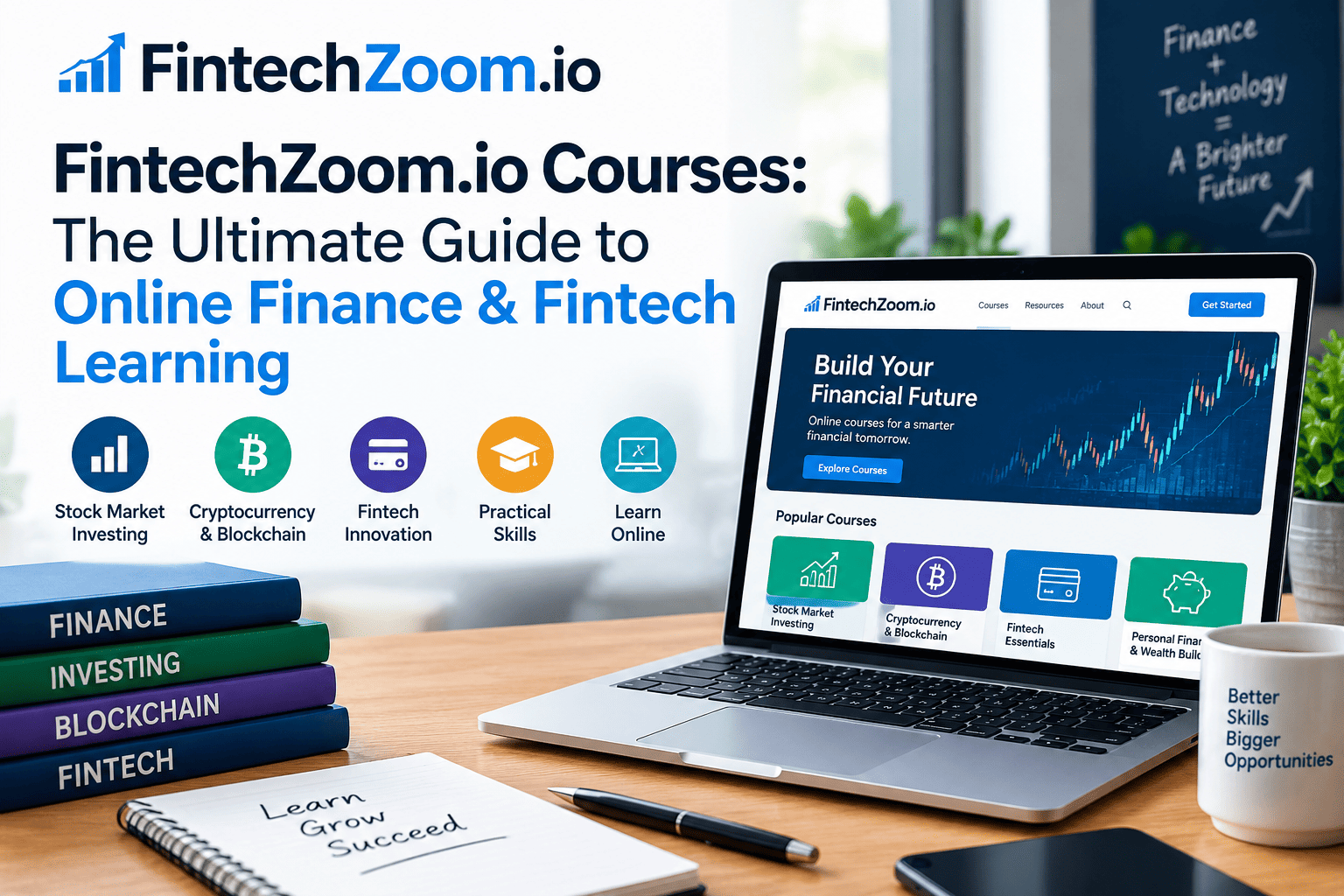
The finance industry is no longer limited to traditional banks, stock exchanges, and physical financial institutions. Technology has transformed the way people invest, make payments, manage money, access banking services, and learn about financial markets.
As digital finance continues to expand, online education has become an accessible way to develop knowledge about investing, financial markets, fintech, and emerging technologies. FintechZoom.io Courses is a topic of interest for learners looking to explore these areas and build a stronger understanding of modern finance.
Whether you are completely new to financial markets or already have some experience with investing and technology, choosing the right educational path can help you understand complex financial concepts more clearly.
This guide explores what finance and fintech courses can cover, how stock market education fits into fintech learning, what to consider before choosing a course, and how these skills can support long-term professional development.
What Are FintechZoom.io Courses?
FintechZoom.io Courses can be understood as a broad topic related to online education in finance, financial technology, investing, and digital financial services.
Depending on the specific educational program, learners may encounter introductory subjects such as financial literacy and stock market basics, as well as more advanced areas including financial analysis, blockchain, digital banking, financial data, and artificial intelligence.
The exact availability and structure of any course can change. Therefore, learners should review the current course information, curriculum, instructors, learning format, and certification details before enrolling.
Why Online Finance and Fintech Learning Is Important
Financial technology is developing rapidly, which means the skills needed to understand modern financial services are also changing.
Online learning provides flexibility for people who want to study finance without following a traditional classroom schedule. Students can explore individual subjects at their own pace, while working professionals can study outside their regular working hours.
Another advantage is specialization. Instead of studying every area of finance at once, learners can focus on the subjects most relevant to their interests, such as stocks, investing, digital banking, cryptocurrency, financial data, or fintech applications.
This flexibility makes online finance education useful for beginners as well as people looking to expand existing knowledge.
What Can You Learn From FintechZoom.io Courses?
A comprehensive finance and fintech learning path can cover several connected areas.
Financial market education can explain stocks, bonds, commodities, currencies, indexes, and other financial instruments. Investing education can introduce risk, diversification, valuation, portfolio concepts, and different approaches to analyzing financial assets.
Fintech education adds another dimension by explaining how technology is being integrated into financial services. Topics may include digital banking, online payments, financial applications, blockchain, financial APIs, automation, and artificial intelligence.
Together, these subjects provide a broader understanding of how modern finance operates.
FintechZoom.io Stock Market Course: Understanding Market Education
For learners particularly interested in stocks, a fintechzoom.io stock market course can be considered as part of a broader financial education journey.
Stock market education generally begins with the fundamentals. Beginners need to understand what stocks represent, how exchanges operate, why prices change, and how companies participate in public markets.
As learners progress, they can explore financial statements, earnings, revenue, dividends, valuation, market capitalization, indexes, and investment risk.
The most important factor when evaluating a stock market course is not simply its title. Learners should examine the actual curriculum to determine whether it provides meaningful education about market fundamentals, analysis, and risk.
Stock Market Fundamentals
A strong introductory curriculum should help learners understand the difference between individual stocks, indexes, exchange-traded funds, and other financial instruments.
It should also explain concepts such as market capitalization, price-to-earnings ratios, dividends, earnings growth, volatility, and diversification.
These concepts provide the foundation needed to understand financial news and company information.
Understanding Stock Analysis
Stock analysis generally involves studying information about a company, its industry, financial performance, and broader market environment.
Fundamental analysis often focuses on financial statements, revenue, earnings, cash flow, debt, and valuation. Technical analysis, by contrast, focuses more heavily on price movements, trading volume, and market charts.
Educational courses may introduce one or both approaches. Learners should understand that analytical methods are tools for evaluating information and do not guarantee future market performance.
Investing Fundamentals for Beginners
Investing education should begin with a clear understanding of risk and return.
Different financial assets carry different levels of risk, and an investment strategy that may be appropriate for one individual may not be appropriate for another. Factors such as financial goals, time horizon, diversification, and personal circumstances can influence investment decisions.
A good educational program should therefore focus on understanding these concepts rather than promising specific financial outcomes.
For beginners, learning how to interpret financial information can be more valuable than immediately trying to predict short-term market movements.
Fintech and Digital Finance
Fintech refers broadly to the use of technology to provide, improve, or automate financial services.
Digital banking is one of the most visible examples. Customers can now perform many banking activities through mobile applications and online platforms without visiting a physical branch.
Digital payments have also changed everyday financial transactions. Mobile wallets, online payment systems, payment gateways, and real-time transaction technologies have become important parts of the modern financial ecosystem.
Learning about these technologies can help students understand how traditional financial institutions and technology companies are interacting.
Cryptocurrency and Blockchain Education
Cryptocurrency and blockchain are increasingly important subjects within fintech education.
A fintech curriculum may introduce Bitcoin, blockchain networks, digital assets, smart contracts, tokenization, and decentralized finance. These subjects combine financial concepts with computer technology.
However, responsible education should also explain the risks involved. Cryptocurrency markets can be highly volatile, while blockchain applications can involve technical, regulatory, and security considerations.
Understanding the underlying technology is therefore an important part of studying this field.
Artificial Intelligence in Finance
Artificial intelligence is becoming increasingly relevant to financial services.
Financial institutions and technology companies can use AI-related systems for areas such as data analysis, customer service, fraud detection, automation, and risk assessment.
AI education within fintech can help learners understand how large amounts of financial information can be processed and analyzed using modern technologies.
As AI continues to develop, understanding both its potential applications and limitations will become increasingly important for finance professionals.
How to Choose the Right Fintech Course
Choosing an online course should begin with your learning objective.
A complete beginner may need an introductory course covering financial terminology, markets, and basic investing concepts. Someone with existing financial knowledge may instead prefer advanced subjects such as financial modeling, quantitative analysis, blockchain development, or financial data.
The curriculum should be one of the first things you examine. Look for clear learning objectives and information about the subjects covered.
It is also useful to consider the instructor’s background, course format, duration, practical assignments, assessment methods, and certification details.
Most importantly, the course should match your actual goals rather than simply having an attractive title.
How to Build a Strong Finance Learning Path
A gradual approach can make financial education easier.
Start with basic financial literacy and learn how banking, markets, money, and financial products work. Once these fundamentals are clear, move toward stocks, bonds, indexes, investing, and market analysis.
After developing a foundation in finance, learners can explore fintech subjects such as digital payments, online banking, blockchain, financial applications, and AI.
More advanced learners can then move into financial data analysis, financial modeling, quantitative finance, or specialized fintech technologies.
This progression creates a connection between traditional financial knowledge and modern technology.
Who Can Benefit From Fintech and Stock Market Courses?
Finance and fintech courses can be useful for different types of learners.
Students may use them to explore finance-related careers and understand whether they want to pursue investing, banking, financial technology, or data analysis.
Working professionals can use additional education to develop knowledge of emerging financial technologies and stay familiar with changes within the industry.
Entrepreneurs can benefit from understanding digital payments, financial platforms, and technology-driven business models. Technology professionals can also gain valuable financial knowledge that helps them work on products for banks, investment companies, payment providers, and fintech businesses.
People interested specifically in stocks may focus more heavily on market education and stock analysis.
Skills You Can Develop Through Finance Education
The value of a finance course extends beyond memorizing financial terms.
A well-designed learning program can help develop financial literacy and analytical thinking. Learners can become more comfortable interpreting financial information, comparing different financial concepts, and understanding relationships between markets and businesses.
Fintech education can add technology awareness by explaining how software, data, automation, and digital infrastructure are being used in financial services.
Combining these skills can provide a broader understanding of the modern financial ecosystem.
Career Opportunities in Finance and Fintech
Finance and technology now overlap across many professional areas.
Depending on their education and experience, learners may explore fields such as financial analysis, banking, investment research, financial data, risk management, digital payments, compliance, fintech product development, consulting, and technology.
A stock market course can provide useful background for someone interested in market research or financial analysis, while broader fintech education may be relevant to digital banking, payment technology, blockchain, or financial software.
However, completing a course by itself does not guarantee a job or a particular career result. Employers may also consider formal qualifications, practical experience, technical skills, communication abilities, and industry knowledge.
Common Mistakes to Avoid When Learning Finance
One of the most common mistakes is choosing an educational program based only on its name. The actual curriculum and learning outcomes are much more important.
Another mistake is treating financial education as a shortcut to guaranteed investment profits. Financial markets involve uncertainty, and no educational program can remove market risk.
Beginners may also make the mistake of skipping basic concepts and immediately moving to advanced strategies. A strong foundation can make more complex subjects easier to understand.
Finally, learners should avoid relying on a single source of information. Combining courses with reputable financial publications, official company information, research, and practical exercises can provide a broader learning experience.
How to Get the Most From an Online Finance Course
Active learning can make a major difference.
Instead of simply watching lessons, learners can take organized notes and revisit difficult concepts. Reading company reports and studying historical financial information can also help connect theoretical knowledge with real-world examples.
For stock market learners, practicing how to read basic financial information can strengthen analytical skills. For fintech students, exploring examples of digital banking, payments, blockchain, and AI applications can make technology concepts easier to understand.
The goal should be to develop understanding that can be applied beyond the course itself.
The Future of Finance and Fintech Education
The relationship between finance and technology is likely to remain an important area of professional education.
Artificial intelligence, machine learning, blockchain, open banking, real-time payments, embedded finance, cybersecurity, and financial data are influencing the way financial services are designed and delivered.
As these technologies evolve, financial professionals may need to continue updating their knowledge. This makes lifelong learning increasingly relevant to people working across finance and technology.
Future educational programs are likely to place greater emphasis on combining financial fundamentals with data, technology, automation, and practical applications.
Frequently Asked Questions
What are FintechZoom.io Courses?
FintechZoom.io Courses is a broad topic related to online learning in finance, fintech, investing, financial markets, and digital financial technology. The exact course offerings and curriculum depend on the relevant provider.
What is a fintechzoom.io stock market course?
A fintechzoom.io stock market course refers to stock market-focused learning within the broader finance and fintech education topic. Learners should review the actual syllabus and provider information to understand what the course covers.
Are fintech courses good for beginners?
Beginner-friendly courses can introduce financial terminology, market fundamentals, investing concepts, and basic fintech subjects before learners move toward more advanced areas.
Can I learn stock market basics through an online course?
Yes. Online stock market education can introduce subjects such as stocks, indexes, valuation, dividends, financial statements, diversification, and market risk.
Do fintech courses cover cryptocurrency?
Some courses include cryptocurrency, blockchain, and decentralized finance, while others focus primarily on digital banking, payments, investing, or financial data.
How should I choose a stock market course?
Look at the curriculum, instructor experience, course structure, practical exercises, learning format, and level of difficulty. The course should match your existing knowledge and learning objectives.
Final Thoughts
FintechZoom.io Courses: The Ultimate Guide to Online Finance & Fintech Learning demonstrates how online education can connect traditional financial knowledge with modern technology.
From stock market fundamentals and investing to digital banking, cryptocurrency, blockchain, artificial intelligence, and financial data, learners have many areas to explore.
For readers interested specifically in stocks, a fintechzoom.io stock market course can fit into a broader financial learning path. The key is to focus on educational quality, relevant subject matter, practical understanding, and a clear progression from basic concepts to more advanced topics.
As the financial industry continues to evolve, developing both financial knowledge and technology awareness can help learners better understand the changing world of finance.