
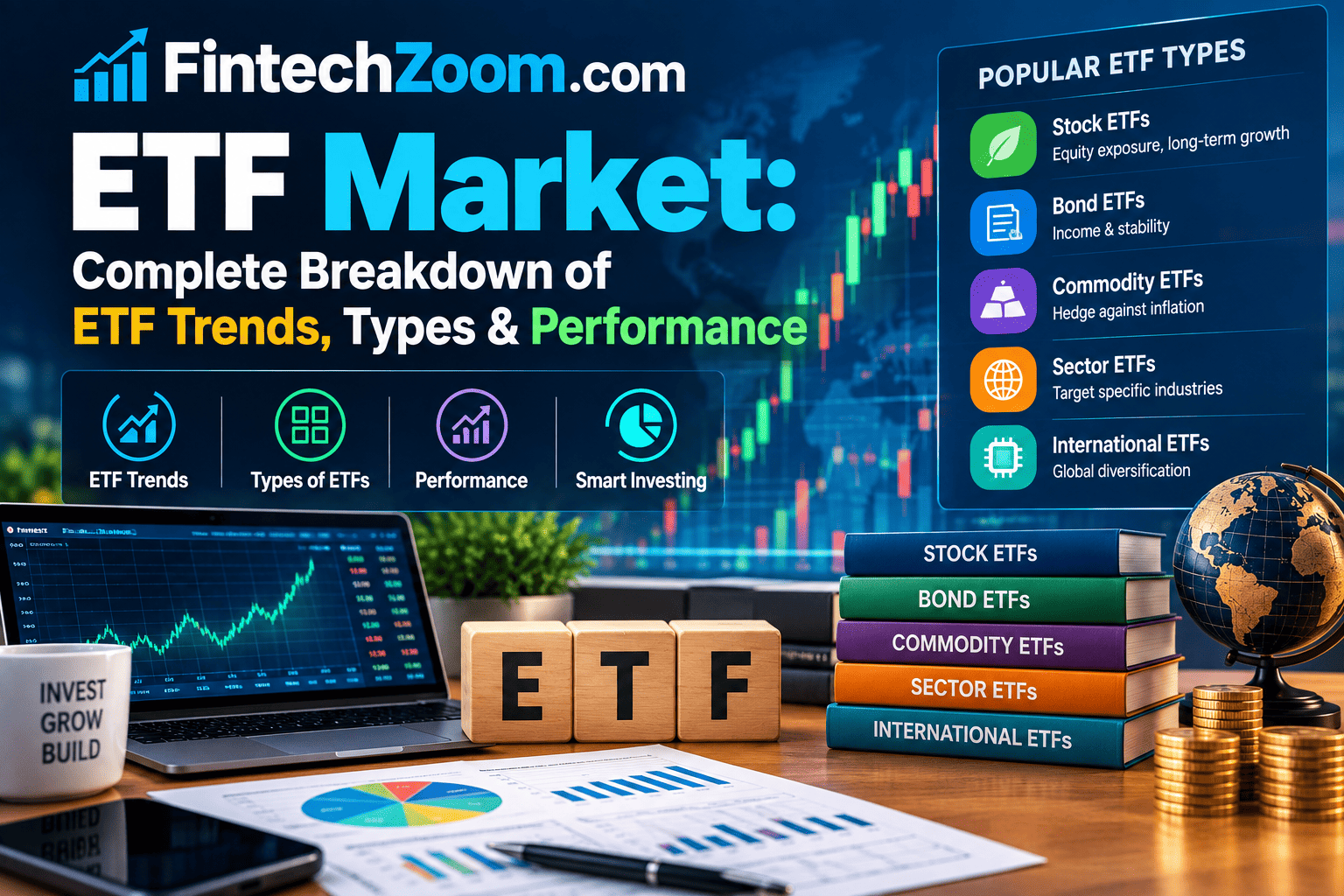
Exchange-traded funds (ETFs) have become an important part of modern financial markets. They provide investors with exposure to stocks, bonds, commodities, sectors, indexes, and other assets through a single exchange-traded product.
The FintechZoom.com ETF Market is a useful topic for anyone researching ETF categories, market trends, fund performance, trading activity, and the factors that can influence ETF prices. From broad-market index ETFs to specialized funds, the ETF landscape offers a wide range of options and strategies.
Understanding how ETFs work, what they hold, how they track benchmarks, and what risks they carry can help readers make better-informed decisions when researching the market.
Note: This article is for informational and educational purposes only and does not constitute financial or investment advice.
What Is an ETF?
An ETF, or exchange-traded fund, is an investment fund whose shares trade on a stock exchange during regular market hours.
An ETF can hold a collection of securities or other assets and may be designed to track a specific index, sector, commodity, geographic region, or investment strategy.
Common ETF exposures include:
- Broad stock-market indexes
- Technology companies
- Government bonds
- Corporate bonds
- Gold and other commodities
- International markets
- Dividend-paying stocks
- Specific industries
- Thematic investment areas
Unlike many traditional mutual funds, ETFs can generally be bought and sold throughout the trading day at market prices.
How the FintechZoom.com ETF Market Works
When examining the FintechZoom.com ETF Market, it is important to look beyond an ETF’s current share price.
Several factors can help explain an ETF’s market behavior:
| ETF Factor | What It Indicates |
| ETF Price | Current trading value of the ETF |
| Trading Volume | Level of buying and selling activity |
| Assets Under Management | Approximate size of the fund |
| Expense Ratio | Annual operating expenses |
| Holdings | Securities or assets owned by the ETF |
| Benchmark | Index or market measure the ETF follows |
| Historical Performance | Previous performance over different periods |
| Bid-Ask Spread | Difference between buying and selling prices |
| Tracking Difference | How closely the ETF follows its benchmark |
Considering several of these factors together can provide a more complete understanding of an ETF than looking at price alone.
Major Types of ETFs
The ETF market includes numerous fund structures. Each type can have a different objective, level of diversification, risk profile, and underlying asset exposure.
1. Equity ETFs
Equity ETFs invest primarily in stocks.
Some track broad indexes, while others concentrate on specific sectors, industries, company sizes, or geographic markets.
Common equity ETF categories include:
- Large-cap ETFs
- Small-cap ETFs
- Technology ETFs
- Healthcare ETFs
- Financial ETFs
- Dividend ETFs
- International equity ETFs
- Growth-oriented ETFs
- Value-oriented ETFs
Equity ETFs can provide exposure to multiple companies through a single fund.
2. Bond ETFs
Bond ETFs provide exposure to fixed-income securities.
Depending on the fund, holdings may include:
- Government bonds
- Corporate bonds
- Municipal bonds
- Treasury securities
- International bonds
- Short-term or long-term debt
Bond ETF performance can be influenced by interest rates, credit conditions, inflation expectations, and changes in bond prices.
3. Commodity ETFs
Commodity ETFs provide exposure to commodities such as gold, silver, energy products, or agricultural markets.
Commodity-related ETFs can be affected by:
- Supply and demand
- Inflation expectations
- Currency movements
- Global economic activity
- Geopolitical developments
- Weather conditions
- Production levels
Because commodities can experience significant price fluctuations, commodity ETFs may behave differently from traditional equity ETFs.
4. Sector ETFs
Sector ETFs focus on specific areas of the economy.
| Sector | Common Exposure |
| Technology | Software, semiconductors, hardware |
| Healthcare | Pharmaceuticals, biotechnology, medical devices |
| Financials | Banks, insurance, financial services |
| Energy | Oil, gas, energy infrastructure |
| Industrials | Manufacturing, transportation, infrastructure |
| Consumer | Retail, food, household products |
| Communication | Media, telecom, communication services |
Sector ETFs can provide targeted exposure, although they may be less diversified than broad-market ETFs.
5. International ETFs
International ETFs provide exposure to companies or securities outside an investor’s domestic market.
These funds may focus on:
- Developed markets
- Emerging markets
- Individual countries
- Regional markets
- Global companies
International ETFs can introduce additional considerations such as currency movements, geopolitical developments, and differences between financial markets.
6. Index ETFs
Index ETFs are designed to track a particular market index or benchmark.
For example, an index ETF may seek to replicate the performance of a broad stock-market index.
When researching index-based ETFs, it can be useful to understand the underlying benchmark. Topics such as Fintechzoom.com Indexdjx can be relevant when exploring index movements, market benchmarks, and the relationship between indexes and exchange-traded funds.
An ETF’s performance may differ slightly from its benchmark because of:
- Fund expenses
- Trading costs
- Portfolio adjustments
- Cash holdings
- Tracking differences
ETF Market Trends
The ETF market continues to evolve as investor preferences, technology, economic conditions, and financial markets change.
Several trends are particularly relevant when researching ETFs.
Growing Interest in Low-Cost Funds
Costs are an important consideration when comparing ETFs.
The expense ratio represents the annual operating expenses of a fund as a percentage of assets. A lower expense ratio can reduce the cost of maintaining exposure, although expense ratio should not be the only factor considered.
Other characteristics include:
- Fund objective
- Holdings
- Liquidity
- Tracking quality
- Historical behavior
- Risk exposure
Expansion of Thematic ETFs
Thematic ETFs focus on specific trends or investment themes.
Examples include:
- Artificial intelligence
- Cybersecurity
- Robotics
- Clean energy
- Biotechnology
- Digital infrastructure
- Semiconductor technology
These funds can provide targeted exposure but may also have greater concentration than broad-market ETFs.
Increasing Interest in Bond ETFs
Bond ETFs have become an important component of the ETF market.
Interest-rate movements are particularly relevant for bond funds. When interest rates change, bond prices can respond, which can influence the value of bond ETFs.
Investors researching bond ETFs may therefore examine:
- Duration
- Yield
- Credit quality
- Maturity
- Interest-rate sensitivity
ETF Performance Explained
ETF performance can be measured in several ways.
Looking only at the current price does not provide a complete picture of how a fund has performed.
| Performance Measure | Description |
| Price Return | Change in the ETF’s market price |
| Total Return | Price movement plus applicable distributions |
| Benchmark Return | Performance of the ETF’s reference benchmark |
| Volatility | Degree of historical price fluctuations |
| Tracking Difference | Difference between ETF and benchmark performance |
| Expense Ratio | Annual fund operating cost |
Historical performance can help provide context, but past performance does not guarantee future results.
ETF Price vs. Net Asset Value
A key ETF concept is the difference between market price and net asset value, commonly called NAV.
Market price is the price at which ETF shares trade on an exchange.
NAV represents the value of the ETF’s underlying assets minus liabilities, divided by the number of outstanding shares.
The market price can sometimes trade above or below NAV because ETF shares trade continuously while NAV calculations follow the fund’s valuation process.
Why This Difference Matters
Understanding NAV can help explain why an ETF’s exchange price does not always exactly match the value of its underlying holdings.
Several factors can affect the relationship between market price and NAV, including:
- Supply and demand
- Market liquidity
- Trading activity
- Underlying asset liquidity
- Market volatility
ETF Trading Volume and Liquidity
Trading volume refers to the number of ETF shares exchanged during a particular period.
Volume can provide useful information about market activity, but it is not the only measure of liquidity.
When researching an ETF, consider:
- Average trading volume
- Bid-ask spread
- Assets under management
- Liquidity of underlying securities
- Market conditions
A fund with substantial assets and liquid underlying holdings may behave differently from a highly specialized ETF with limited underlying-market liquidity.
Benefits of ETFs
ETFs have several characteristics that make them popular financial instruments.
Common advantages include:
- Diversification: A single ETF can hold many securities.
- Exchange trading: Shares can generally be bought and sold during market hours.
- Variety: ETFs cover numerous asset classes and strategies.
- Transparency: Many ETFs regularly disclose their holdings.
- Accessibility: ETFs can provide exposure to broad or specialized markets.
- Cost efficiency: Some ETFs have relatively low operating expenses.
- Flexibility: Investors can choose funds based on different objectives and market exposures.
The actual characteristics vary from one ETF to another.
Risks Associated With ETFs
ETFs are subject to market and investment risks.
Important risks include:
Market Risk
An ETF can decline when the underlying market or assets fall.
Concentration Risk
Sector and thematic ETFs may have significant exposure to a relatively narrow area.
Interest-Rate Risk
Bond ETFs can be affected by changes in interest rates.
Credit Risk
Certain bond ETFs are exposed to borrowers that may experience financial difficulties.
Currency Risk
International ETFs may be affected by changes in foreign exchange rates.
Liquidity Risk
Some specialized ETFs may have lower trading activity or less-liquid underlying assets.
Tracking Risk
An ETF may not perfectly match the performance of its benchmark.
Commodity Risk
Commodity-related ETFs can be influenced by significant changes in commodity prices.
ETFs and Broader Market Trends
ETF prices are influenced by the assets they hold, meaning broader financial-market conditions can have a major effect on performance.
For example:
Economic Conditions → Market Prices → ETF Holdings → ETF Performance
Interest rates, inflation, economic growth, corporate earnings, commodity prices, currency movements, and investor sentiment can all influence different ETF categories.
However, the same economic event may affect two ETFs differently because their holdings and investment strategies can be very different.
ETFs and Cryptocurrency Market Analysis
The ETF market has also increased interest in products and investment discussions related to digital assets.
Cryptocurrency markets can behave differently from traditional stock and bond markets. Bitcoin, for example, can experience significant price movements over relatively short periods.
This is why searches for FintechZoom Bitcoin Price Prediction may appear alongside broader financial-market research. Such prediction-oriented analysis can discuss potential Bitcoin price scenarios, market drivers, and investor sentiment.
However, Bitcoin price analysis and ETF analysis should be treated as separate research topics unless an ETF specifically has cryptocurrency exposure.
When evaluating crypto-related ETFs or funds, researchers may consider:
- Underlying asset exposure
- Fund structure
- Fees
- Trading volume
- Market liquidity
- Regulatory considerations
- Tracking methodology
- Historical volatility
Active vs. Passive ETFs
ETFs can use either passive or active investment approaches.
Passive ETFs
Passive ETFs generally seek to track an index or predefined benchmark.
Typical characteristics include:
- Rules-based portfolio construction
- Benchmark tracking
- Broad or targeted exposure
- Potentially lower portfolio turnover
Active ETFs
Active ETFs use portfolio-management strategies that may involve selecting securities or adjusting portfolio exposure.
They may involve:
- Active security selection
- Portfolio adjustments
- Different levels of turnover
- Potentially different fee structures
When comparing active and passive ETFs, investors should examine the fund’s actual strategy, costs, holdings, and objectives.
How to Research an ETF
A structured research process can make ETF analysis easier.
Step 1: Understand the ETF’s Objective
Determine what market, asset class, index, or strategy the ETF is designed to represent.
Step 2: Examine Its Holdings
Look at the securities, sectors, countries, or assets included in the fund.
Step 3: Review the Expense Ratio
Compare the fund’s expenses with similar ETFs.
Step 4: Examine Historical Performance
Review multiple periods rather than focusing on one recent performance figure.
Step 5: Check Liquidity
Look at trading volume and bid-ask spreads.
Step 6: Identify the Benchmark
Determine which index or benchmark the ETF follows, if applicable.
Step 7: Evaluate Risk
Consider volatility, concentration, interest-rate exposure, currency exposure, and other relevant risks.
ETF Research Checklist
| Research Question | Why It Matters |
| What does the ETF track? | Identifies its primary exposure |
| What are its largest holdings? | Shows concentration |
| What is the expense ratio? | Indicates ongoing fund costs |
| What is the benchmark? | Provides a comparison point |
| How liquid is the ETF? | Helps assess trading conditions |
| What is its historical volatility? | Shows previous price fluctuations |
| Does it use leverage? | Leverage can amplify gains and losses |
| Does it distribute income? | Relevant for income-oriented strategies |
| Does it have international exposure? | May introduce currency and geopolitical risks |
FintechZoom.com ETF Market and Portfolio Diversification
Diversification is one of the main reasons investors research ETFs.
A broad-market ETF can provide exposure to numerous companies through a single security. This can be simpler than purchasing individual stocks separately.
However, ETF diversification should be examined carefully.
Two different ETFs can have different names but still hold many of the same companies.
Therefore, when researching the FintechZoom.com ETF Market, examining actual fund holdings can be more informative than relying solely on an ETF’s name or category.
ETF Trends During Market Volatility
Market volatility can cause ETF prices to move quickly.
During periods of uncertainty, investors may react to:
- Economic data
- Interest-rate expectations
- Corporate earnings
- Inflation reports
- Geopolitical developments
- Commodity prices
- Currency movements
- Changes in market sentiment
Different ETFs can respond differently to the same event because their underlying holdings are not identical.
Volatility is therefore one characteristic to monitor rather than a standalone measure of whether an ETF is appropriate.
Indexes and ETF Market Analysis
Indexes play an important role in ETF research because many ETFs are designed to track specific benchmarks.
An index can represent a particular group of securities or a segment of the financial market.
Understanding index construction can help explain why an ETF moves in a particular direction.
For example, researchers looking into Fintechzoom.com Indexdjx may be interested in how market indexes are structured, how index components influence performance, and how index movements can translate into ETF price changes.
This connection is particularly useful when studying index-tracking ETFs.
Factors That Can Influence ETF Performance
Several factors can influence ETF performance at the same time.
| Factor | Possible Market Impact |
| Interest Rates | Can affect bonds and equity valuations |
| Inflation | Can influence purchasing power and asset prices |
| Economic Growth | Can affect corporate earnings and market demand |
| Currency Movements | Important for international investments |
| Commodity Prices | Relevant for commodity and resource-related ETFs |
| Corporate Earnings | Can influence equity-focused ETFs |
| Investor Sentiment | Can affect buying and selling activity |
| Geopolitical Events | May create short-term market volatility |
These relationships are not fixed. Market reactions can vary depending on circumstances.
The Future of the ETF Market
The ETF industry continues to develop as financial markets, technology, and investor preferences evolve.
Areas that may continue receiving attention include:
- Thematic ETFs
- Artificial-intelligence-focused funds
- Technology ETFs
- Fixed-income ETFs
- International ETFs
- Active ETF strategies
- Sustainable-investment products
- Commodity-focused funds
- Digital-asset-related investment products
The continued expansion of ETF categories means investors have more choices, but it also makes careful research increasingly important.
Final Thoughts
The FintechZoom.com ETF Market provides a useful framework for understanding exchange-traded funds, their different categories, market trends, performance measurements, and associated risks.
ETFs can provide exposure to equities, bonds, commodities, indexes, sectors, international markets, and specialized investment themes. However, each fund has its own structure and risk characteristics.
When researching an ETF, it is useful to consider its holdings, benchmark, expense ratio, liquidity, historical performance, volatility, and investment objective rather than focusing on one metric.
Broader financial topics such as FintechZoom Bitcoin Price Prediction can provide context for cryptocurrency-market discussions, while Fintechzoom.com Indexdjx can be relevant when exploring indexes and index-based ETF strategies. These topics can complement ETF research while representing different areas of the financial markets.
Ultimately, understanding how ETFs work and how market conditions affect them can help readers interpret financial information more effectively and conduct more informed independent research.
Frequently Asked Questions
What is the FintechZoom.com ETF Market?
The FintechZoom.com ETF Market refers to the broader topic of ETF market information, including ETF types, trends, prices, performance, benchmarks, and market analysis.
What is an ETF?
An ETF is an exchange-traded fund that holds a portfolio of assets and whose shares trade on a stock exchange during market hours.
What are the main types of ETFs?
Major categories include equity ETFs, bond ETFs, commodity ETFs, sector ETFs, international ETFs, index ETFs, thematic ETFs, and actively managed ETFs.
How is ETF performance measured?
ETF performance can be evaluated using price return, total return, benchmark comparison, volatility, tracking difference, and other metrics.
Are ETFs risk-free?
No. ETFs can lose value and may carry market, liquidity, concentration, interest-rate, currency, credit, and other risks.
What is an ETF expense ratio?
An expense ratio represents the annual operating expenses of an ETF as a percentage of the fund’s assets.
Why are indexes important for ETFs?
Many ETFs track indexes, so understanding the underlying benchmark can help explain an ETF’s holdings and performance.
What is FintechZoom Bitcoin Price Prediction?
It is a search-oriented topic relating to analysis or forecasts concerning Bitcoin’s potential price movements. Such predictions are uncertain and should not be treated as guaranteed future outcomes.
What does Fintechzoom.com Indexdjx refer to?
It is a search-oriented term associated with index-market information and can be relevant when researching indexes, benchmarks, and index-based financial products.
Can ETFs lose money?
Yes. ETF prices can decline when their underlying assets lose value. The amount of risk depends on the ETF’s holdings, structure, strategy, and market conditions.
[…] FintechZoom.com ETF Market: Complete Breakdown of ETF Trends, Types & Performance FintechZoom.com IndexDJX: Breaking Down Market Indexes, Trends & Signals FintechZoom Bitcoin Price Prediction: BTC Outlook for 2026 and Beyond FintechZoom Stock Market Today: Breaking Down Stocks, Trends & Market Signals FintechZoom.com Corn: From Global Supply to Prices—Market Trends Explained […]